
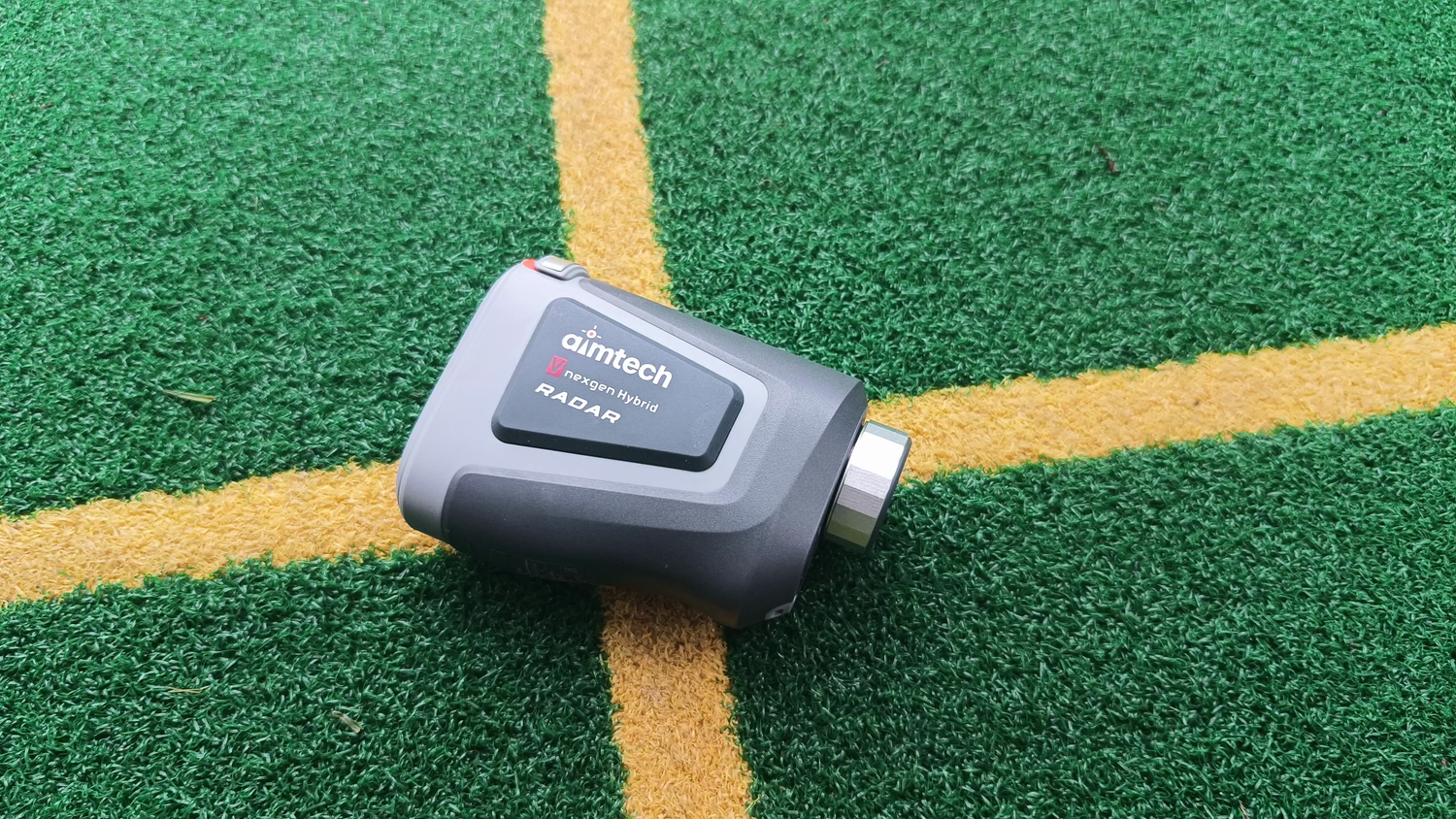
In golf, distance is everything. Whether you are looking to perfectly clear a menacing bunker or nail a crucial approach shot onto the green, having a precise distance measurement tool is like having a master caddie by your side.
However, when browsing for golf rangefinders, you will constantly encounter two tech buzzwords: Laser Measurement and Millimeter-wave Radar. Many golfers can't help but wonder: What is the actual difference between them? And as a handheld device, which technology truly dominates the course?
Today, we are diving deep into the underlying mechanics of these two core technologies and exploring how a revolutionary fusion of both is changing the game of golf forever.
1. Laser Rangefinding: The Ultra-Precise "Straight-Line" Sniper
Laser rangefinding is the most common traditional technology used in golf rangefinders today. Its working principle is straightforward: the device emits an incredibly narrow laser beam towards a target (like the pin) and calculates the distance based on the light’s round-trip time (Time-of-Flight technology, or ToF).
Pros:
Extreme Static Accuracy: Under clear visibility and with a perfectly steady hand, premium laser rangefinders deliver a staggering accuracy of within ±0.3 yards.
Targeted Focus: Point-and-shoot simplicity. Combined with slope compensation and pin-locking features, it locks onto vital distances instantly.
Cons:
Vulnerable to Shaky Hands: The higher the magnification, the more even a tiny hand tremor gets amplified, making it frustratingly difficult to lock onto a distant flagstick on the first try.
Blind Spots: Lasers offer single-point measurement. They can only tell you "how far you are from that exact dot." They cannot perceive your dynamic swing mechanics, club speed, or track the actual flight path of the ball.
2. Millimeter-wave Radar: The All-Weather "Space Commander"
Originally a core technology in autonomous driving and military radar, Millimeter-wave Radar emits electromagnetic waves with wavelengths of 1 to 10 millimeters. It utilizes the Doppler effect to detect an object's distance, velocity, and angle.
Pros:
Superior Penetration: Unlike light beams, millimeter-wave radar is completely unaffected by heavy fog, glaring sunlight, or airborne dust, operating with maximum stability in all weather conditions.
Dynamic Data Tracking: The true power of radar lies in tracking motion data. It measures your Club Speed and Ball Speed, utilizing intelligent algorithms to simulate and calculate the ball's actual Carry Distance (Carry Yds).
Cons:
Because radar beams have a wider scattering angle compared to pinpoint lasers, relying solely on radar for far-distance handheld "single-pin locking" yields less static resolution than a focused laser beam.
3. The Ultimate Game-Changer: Aimtech’s World-First Solution
Since lasers are unparalleled at static distance tracking and radars are unmatched at dynamic data capturing, why not put them both into a single handheld device?
For a long time, due to technical barriers, power consumption limits, and form-factor constraints, golfers had to choose between a single-function laser rangefinder or a bulky, non-portable launch monitor.
Aimtech has shattered this barrier by introducing The World’s First 3-in-1 OIS Radar Golf Rangefinder. By seamlessly integrating these two powerhouse technologies, Aimtech elevates golf gear into the smart era:
A. Radar Detection + Smart Golf Caddy
Aimtech features an embedded, cutting-edge millimeter-wave radar module. When you stand on the tee box or fairway, it doesn't just read a flat number. Instead, it pairs with the Smart Golf Caddy system to map out your layout and recommend optimal landing zones. 108 Yds, 92 Yds, 83 Yds... the entire trajectory and path light up clearly on your screen.
B. AI Training Mode: Your On-the-Go AI Coach
With built-in radar tracking, Aimtech transforms into a pocket-sized golf simulator. Under AI Training Mode, it captures and displays your vital performance data in real-time right after your shot (e.g., Carry: 48.0 yd, Recommended: 48.1 yd; Club Speed: 35.9 mph, Recommended: 36.4 mph). This immediate data feedback acts as an AI coach, giving you actionable insights to fix your swing posture whether you are at the driving range or on the course.
C. Elite Optics: 8x Magnification HD LCD + OIS
To unlock the full potential of laser rangefinding, Aimtech tackles the industry's biggest headache: hand tremors. It introduces hardware-level Optical Image Stabilization (OIS). Even at an ultra-sharp 8x Magnification, the viewfinder remains rock-steady.
Coupled with a lightning-fast 0.3s Pin Lock and an expansive Max Range of 1100 yards, you can confidently lock onto the flag in just 0.3 seconds with an elite accuracy of ±0.3 yards, even on blustery days.
Golf is a discipline of precision and control. Relying on single-line technologies always meant compromising on either distance accuracy or data feedback. Aimtech removes that compromise entirely by stacking Millimeter-wave Radar, Laser Rangefinding, and OIS together. It is no longer just a tool to measure distance; it is a smart AI companion designed to lower your handicap. If you are looking for a device that kills hand jitter while serving up pro-level swing data, Aimtech is the ultimate upgrade for your golf bag this year.
4. Frequently Asked Questions
Q1: How does Aimtech's radar feature differ from expensive launch monitors on the market?
A: Traditional launch monitors are bulky, cost thousands of dollars, and must be statically set up behind the player. Aimtech miniaturizes millimeter-wave radar technology for the very first time, combining it into a sleek handheld rangefinder. It offers your essential club speed, ball speed, and carry metrics on the go while allowing you to actively scan the green for smart route planning.
Q2: What is OIS, and does it actually make a difference in golf tracking?
A: Absolutely. Most traditional rangefinders suffer from violent screen shakes at higher magnifications (6x or above) due to natural hand tremors, making it tough to aim. Aimtech employs physical Optical Image Stabilization (OIS)—similar to high-end DSLR cameras and flagship smartphones—adjusting the internal lenses dynamically to compensate for hand movements. This ensures an instantly stabilized view at 8x magnification for a quick 0.3s pin lock.
Q3: Can I still use the radar feature in heavy fog or rain?
A: Yes, perfectly! This is where millimeter-wave radar truly outshines traditional optics. Because of its specific wavelength, radar waves effortlessly pierce through water vapor, dense fog, and dust. When traditional lasers fail due to fog refraction, Aimtech's radar remains completely operational, securing your environmental awareness and shot tracking.
Q4: Does this rangefinder include classic slope compensation features?
A: Yes. Alongside its advanced radar and stabilization systems, Aimtech comes fully equipped with a dedicated Slope Mode. It automatically computes the angle-adjusted distance based on uphill or downhill slopes, ensuring you always select the perfect club regardless of the course elevation.